Hi, I'm
Kabilan Senapathy
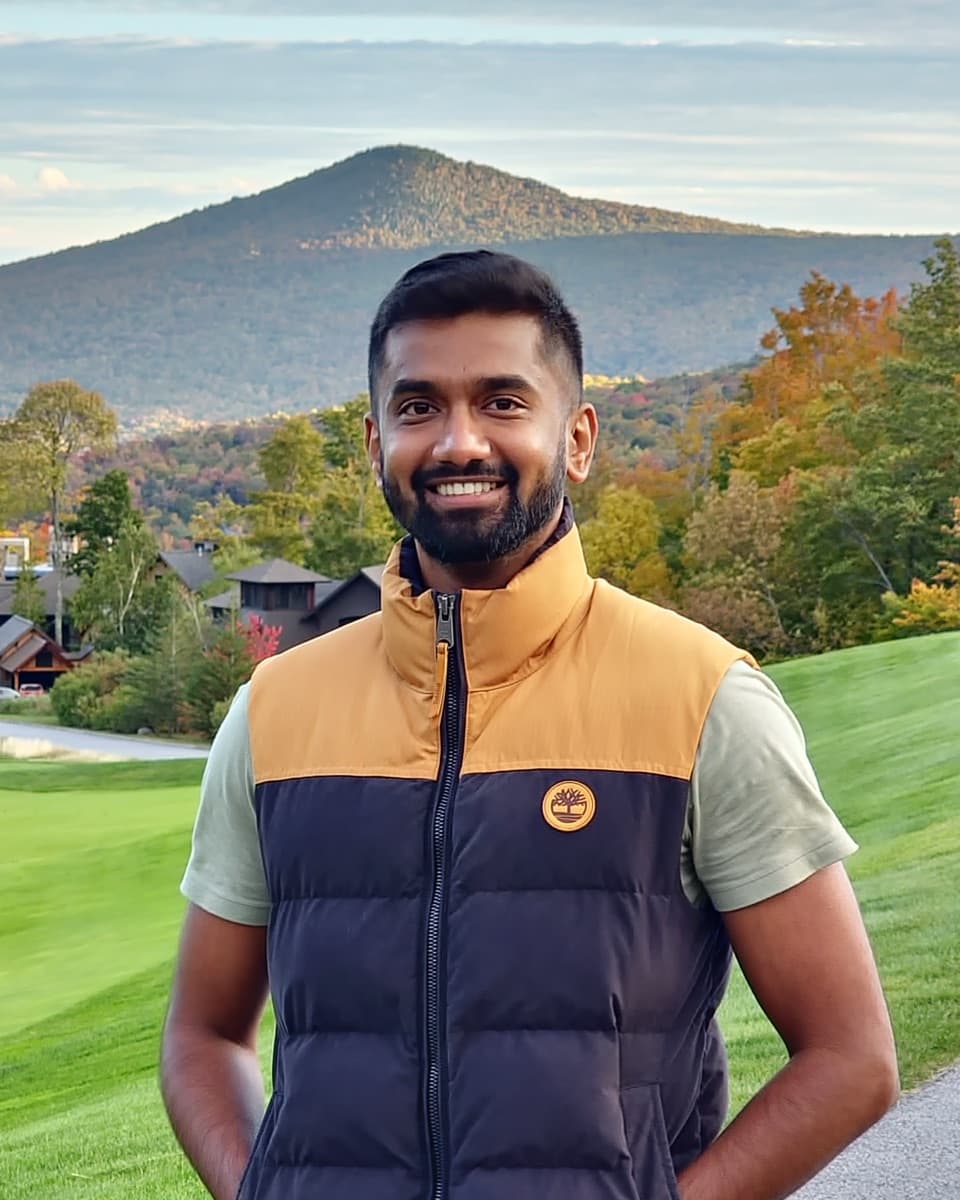
I'm a data scientist in advertising at Paramount, building the ML models and causal measurement behind real-time ad bidding, yield and audience identity. Outside work, I ship AI products, like Recall, a memory app on the App Store.
6+ years in data science, building software since 2015. MS in Data Science. Based in Seattle.
I'm fascinated by randomness in data and in nature. Passionate about On-Device ML and WebML.
Experience
Data Scientist · Paramount
May 2022 - Present4B/day
ad requests in scope for the bid-success model
3.9×
bid rate in the model's top 10% of predictions
9% → 80%
of ad requests carrying a prediction, after the fixes
- Measured the revenue impact of identity signals in programmatic advertising with a cohort-based difference-in-differences design, where A/B testing wasn't possible. Featured in the CTO's 2024 top tech accomplishments and presented company-wide.
- Sole data scientist on a real-time bid-success model for about 4 billion ad requests a day. Built explainable by design (SparkML, MLflow); its top 10% of predictions drew bids 3.9x as often as average. Replaced a leaky random split with a time-based one, reporting a lower but honest AUC.
- Traced why only 9% of ad requests carried a model prediction to a storage issue in another team's system; after the fixes, coverage reached 80%.
- Created the session-depth methodology now used in ad platform reporting, and recommended the identity resolution order now in production model serving.
- Defined advertiser churn with the Sales VP, adopted by Sales, and built SHAP-explained churn models.
- Mentored two summer interns through to shipped data quality tools, including scoping the problem and plan for one of them.
Data Science Associate · iCreditWorks
Feb 2020 - May 2022$250K/yr
saved by automating daily financial reconciliation
- Automated daily financial reconciliation with fault-tolerant Airflow pipelines, saving about $250K a year.
- Built real-time executive dashboards on credit profiles, product performance and conversion for the CEO, CFO and CTO.
MS, Data Science · New Jersey Institute of Technology
2018 - 2019- Graduate coursework in machine learning, deep learning, statistics and data visualization. Projects are listed under Academic Projects below.
Co-Founder · Algorism Labs
2017 - 2018- AI startup for small and mid-size businesses. Built a property rating and matching algorithm and a custom real-estate ERP.
Lead Software Developer · Lands and Lands Ventures
2015 - 2017- Built ERP, CRM and analytics covering 6K+ properties and 10K+ customers.
Things I've Built

Recall: The Memory App↗
Launched on the App Store in June 2026 · Built solo
A memory journal you can ask questions in plain English. The iOS and macOS app tags memories on device with Apple's NLTagger. The backend runs a RAG pipeline: pgvector search over OpenAI embeddings, LLM query rewriting, keyword and date passes, and expansion through linked memories, streamed back over SSE.
147
users
929
memories saved
5.0★
App Store rating

Stratrent↗
Data-driven rent negotiation · Launched March 2026
A free calculator that shows whether renewing a lease or moving saves more money, comparing real monthly costs, moving expenses and landlord concessions side by side.
On-Device ML
Three levels of ML, running entirely in your browser
Pure Math ML
A 2-2-1 neural network learns XOR in your browser, with the forward pass and backpropagation written by hand. No ML libraries.
Train it on XOR →2TensorFlow.js CNN
Train a ~440-parameter super-resolution CNN on 48 video frames on your device, then upscale a frame it has never seen.
Train the CNN →3LLM on Device
Chat with Llama 3.2 1B running locally on WebGPU. Your messages never leave the browser.
Chat with the LLM →Is your device ML ready?
…
demos can run on this device
- Pure Mathready
- TensorFlow.jschecking
- LLMchecking
…
- logical cores
-
Not exposed by this browser
-
Not exposed by this browser
…
WebGPU checking · WebGL checking
Writing
- Agentic AI — House of CardsApr 2025
- Diving into Ray Data: Scalable Datasets for MLJan 2025
- Introduction to Data ScienceAug 2024
Reading
Reading now
Why Machines Learn: The Elegant Math Behind Modern AI
Anil Ananthaswamy
My current coffee-table read, with great formulas and explanations.
OpenIntro Statistics
David Diez, Mine Çetinkaya-Rundel and Christopher Barr
My daily practice book: I solve one problem a day.
Read
The Hindu Speaks on Scientific Facts, Vols. 1 & 2
The Hindu
Where my deepest love for science began, as a teenager.
How to Lie with Statistics
Darrell Huff
A great first book for building a reading habit as a data scientist.
Hypothesis Testing: A Visual Introduction to Statistical Significance
Scott Hartshorn
My coffee-desk read for building a technical reading habit.
Skills
Languages & Data
ML & Statistics
GenAI & On-Device
Platforms
Apps & Visualization
Academic Projects
MS, Data Science · New Jersey Institute of Technology · 2018 - 2019
Machine Learning
Single Nucleotide Polymorphism Classification2018
Used ensemble methods to classify single nucleotide polymorphism (SNP) genotype data (synthetic) of 4,000 cases and 4,000 controls. The data had 29,623 features, of which only 15 were causal. Used PCA to reduce dimensionality and achieved a Top-1 accuracy of 66.2%.
Adaptive Step Size - Hinge Loss and Least Squares Loss2018
Developed a single-layer neural network in Python and implemented an adaptive learning rate for gradient descent. Applied it to both hinge loss and least squares loss and studied the effect of the learning rate on convergence.
View project
Deep Learning
Kaggle Dataset - Image Classification2019
Developed multiple Convolutional Neural Network classifiers in Keras for a wide range of Kaggle image classification datasets.
Mini-ImageNet Classification2019
Developed a 5-layer CNN for Mini-ImageNet classification with a minimum accuracy target of 80%. Used 50% dropout on every layer, an unusually high value that performed well, and studied the effect of high dropout during training.
Medical AI
Feature Space Transformation for Multi-Modality Data2019
Built a transformer that maps data from multiple unknown distributions into a known feature space. A single common model can then serve data from different modalities, reducing development time and engineering effort.
Data Visualization
Visualization for Data Discovery in Open Data Portals (Discovery)2019
Helps users visually understand the links between arbitrary datasets and what information those links provide (e.g., linking datasets A, D and C might provide less information than linking datasets G, D and F).
View project